
Military & Veterans Affairs logo
  • BENEFITS AND SERVICES
    • Disability CompensationReceive financial assistance for service-connected disabilities.
    • Veterans PensionSecure a stable income through veteran pension programs.
    • Education & TrainingAccess education assistance, financial aid, and training options.
    • Healthcare LocationsAccess quality healthcare tailored to your specific needs.
    • Death and Burial BenefitsEligible veteran families can receive financial assistance for funeral expenses.
    • Benefits for SurvivorsSupport your family with resources and financial assistance.
    • Frequently Asked QuestionsFind answers to common questions about MVA.
    • Pledge Vet ProgramBe recognized and lead the Pledge of Allegiance at a Board of Supervisors meeting.
  • VPAN
  • PATRIOTIC HALL
    • Host Your Event
    • Event Calendar
  • ABOUT US
    • Exective BiosMeet the leaders driving the departments work across Los Angeles County.
    • News and ResourcesLatest news and updates on MVA.
    • Join UsBe a part of the workforce.
    • Advisory CommissionProviding oversight and facilitating community engagement.
    • Board CommissionersLearn about the people providing strategic guidance for MVA.
    • Commission Meeting ArchivesAccess recordings, agendas, and minutes of advisory commission meetings.
  • PARTNER RESOURCES
  • CONTACT
    • Schedule an Appointment
    • Submit a Request
    • Submit a Language Access Request
Posts By :

Ashley Cohen

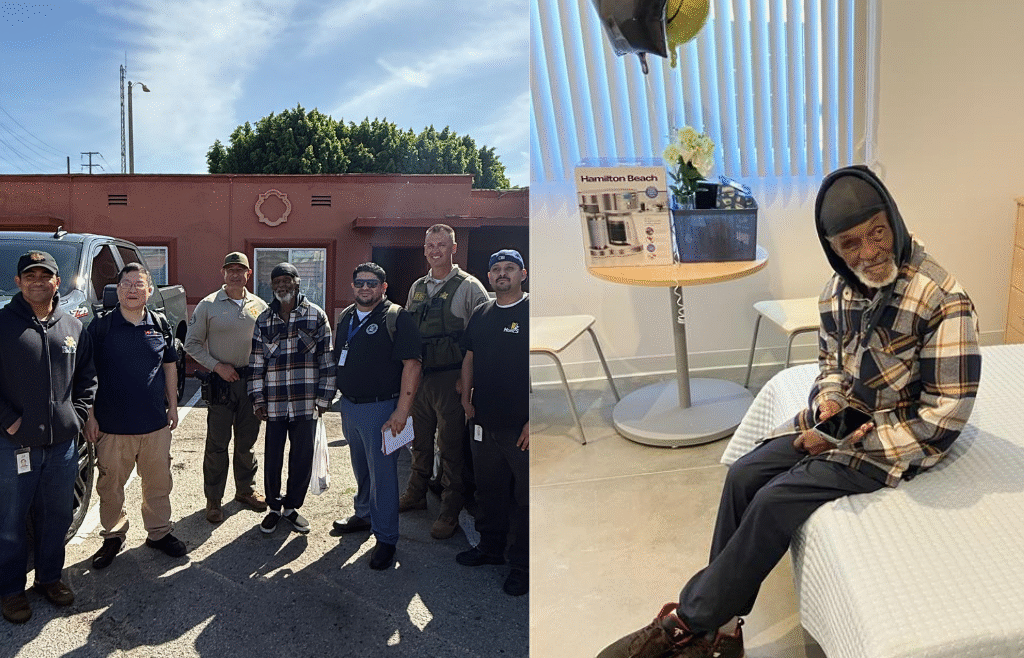
Split image showing a veteran with outreach staff as he is placed into temporary hotel lodging on the left, and on the right, the same veteran seated in his room at St. Andrews supportive housing, marking his transition into stable housing.

From Outreach to Stability: A Veteran’s Turning Point

LOS ANGELES (April 2026) — What began as a routine Pathway Home Operation in Compton on April 2 became a turning point for 73-year-old Army veteran Ronald Branscomb, guided by a network of partners and his own commitment to stay on track. 

“I was sleeping in the back seat of a friend’s car. You’re not getting steady sleep. It takes a lot out of you,” Branscomb said about his situation leading up to the encounter. 

After losing his identification and his phone, Branscomb lost contact with his caseworker and access to services, pulling him back into homelessness, but things began to turn around when he encountered deputies from the Veteran Homeless Outreach Services Team (VHOST). 

“When he saw us, he recognized the uniform and knew we were there to help,” said Los Angeles County Sheriff’s Department Sgt. John D. Strosnider, a Marine Corps veteran assigned to VHOST. 

Immediately after that interaction, partners including the Los Angeles Homeless Services Authority (LAHSA), the Los Angeles County Department of Homeless Services and Housing (HSH), People Assisting the Homeless (PATH), the U.S. Department of Veterans Affairs Homeless Outreach program, and Homeless Outreach Program Integrated Care System (HOPICS) coordinated efforts to stabilize Branscomb’s situation and link him to support, including securing temporary lodging through a hotel voucher. 

“You never know what someone is going through on their own,” said Los Angeles County Sheriff’s Department Deputy Julian Ayon Jr., an Army veteran with VHOST who first approached Branscomb. “When you get them to the right people, it becomes a whole different situation for them.” 

With a place to rest and regroup, Branscomb was then referred to the Veteran Peer Access Network (VPAN) in Supervisorial District 4 (VPAN SD4), Veterans Stand Together, where he met Veteran Peer Specialist Luis Lopez, who helped him get a phone and move forward with replacing his identification. 

“It’s incredibly rewarding to be able to help my comrades. Ronald is an Army veteran—a brother in arms—even though we served in different eras,” said Lopez. “There’s a bond of camaraderie we share, rooted in the belief that you never leave a fallen brother behind. That bond is why we do this work: so a veteran knows they’re not fighting alone and that someone has their back.”

Though they served in different eras, Branscomb and Lopez share a common bond as Army veterans, a connection that helped build trust and understanding in those early moments. 

“It feels good. This is a chance for me to rest and get my thoughts back in line,” Branscomb said after settling into his room. “I wasn’t good at doing it by myself. I see good help now, so I’ve got to stay focused and be available.” 

From there, Lopez stayed alongside Branscomb, helping coordinate with the Los Angeles County Department of Military and Veterans Affairs (MVA) Homeless Services Division (HSD) to move him toward more stable housing. On April 15, he moved into St. Andrews, a supportive housing site in Downtown Los Angeles, a significant milestone in his path toward stability. 

For Branscomb, this moment marked a change. After years of instability, he spoke about approaching what comes next with a renewed sense of focus. 

“Working with people who really care gives me hope,” Branscomb said. “It makes me want to stay committed and keep moving forward.” 

Story by Ashley Cohen, Public Information Associate, Los Angeles County Department of Military and Veterans Affairs
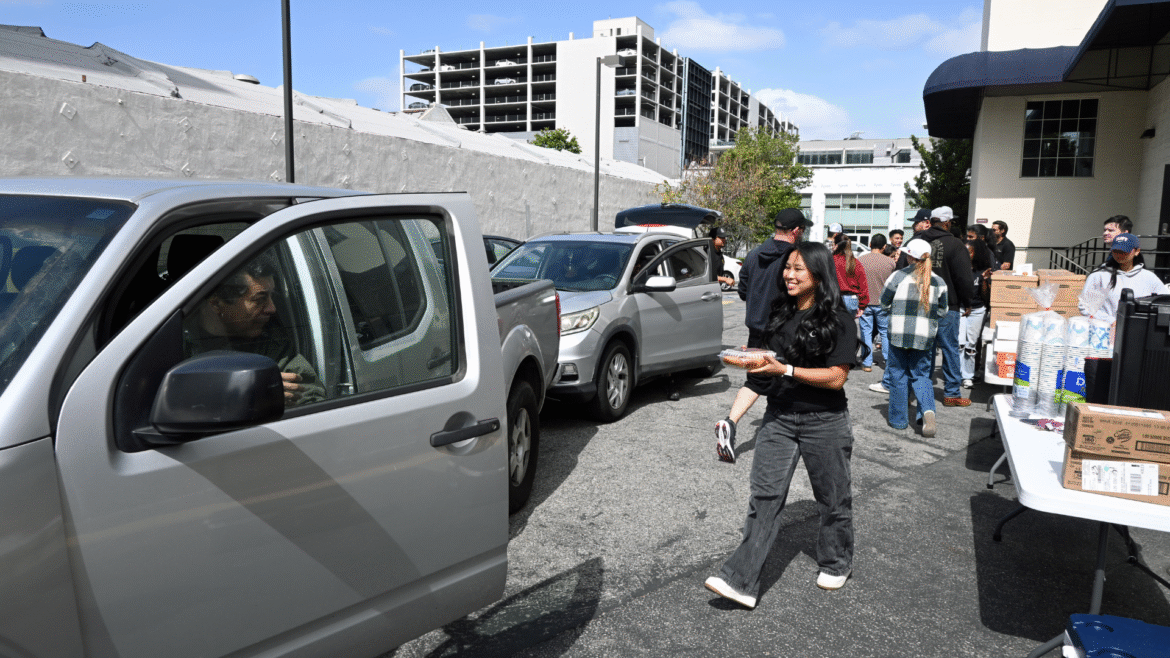
Volunteers distribute food and drinks to people in cars during a drive-through event, handing items through car windows while others gather near tables with supplies in a parking lot.

Veterans and Volunteers Deliver Support to Foster Families at BHPH

LOS ANGELES (April 2026) — On the morning of Saturday, April 25, the Warrior Heritage Foundation (WHF) hosted a food distribution at Bob Hope Patriotic Hall, where veterans, students, and community partners packed and distributed food boxes for more than 100 foster families connected to the Los Angeles County Department of Children and Family Services (DCFS). 

The effort was supported by a $25,000 donation of shelf-stable food from Amazon and carried out with volunteers from the Los Angeles County Department of Military and Veterans Affairs (MVA) and student groups from the University of Southern California (USC), reflecting a shared commitment to service that extended beyond the veteran community. 

“A sense of service is what leads many to join the military,” said Patricia Garza, Operations Director with WHF and lead coordinator for the event. “It’s about continuing to give back after service and finding ways to support other communities in need in a way that brings people together.” 

Throughout the morning, volunteers packed hundreds of boxes full of food, loaded them into cars, and handed out coffee and donuts to families as they arrived, offering small comforts alongside essential support.  For some, the day was more than service. It was personal. 

Jose Jimenez, a Marine Corps veteran and USC student, has legal guardianship of his younger siblings after receiving support through DCFS, giving him a direct connection to the families arriving that morning. 

“Seeing these families, that was me at one point in time,” he said. “Being able to serve them and help them out and give them a smile, it’s a real full-circle moment for me, it’s a real blessing.” 

He said something as simple as a food box can make a meaningful difference for families navigating multiple challenges. 

“It gives us something, one less thing to worry about,” he said. “Because there’s already so many things that are going on in our lives.” 

Across the room, volunteers worked side by side, moving boxes and greeting families as they arrived. 

“I love service,” said Simone Bent, Veterans Claims Assistant III, MVA. “Service is one of the biggest ways to instill change.” She said what stood out most was the mix of people showing up. “We have individuals who are in school, younger generation. We have older individuals. It’s a collective effort, and it gives me hope.” 

She also emphasized the importance of how veterans are understood through that work. 

“We’re not a vulnerable population,” Bent said. “We’re strong… we just need a hand up. We need empathy, not sympathy.” 

For student volunteers like Tehya Romero, a USC sophomore and Naval ROTC midshipman, the day reinforced her connection to service. 

“Everyone says you want to be part of something greater than yourself,” Romero said. “And I think it’s totally true.” She added, “I’m so glad I got to come out and just help out, be part of something greater than myself.” 

By the end of the morning, hundreds of boxes had been distributed, but for many, the impact was found in the connections made along the way. 

“Being able to do something like this… I’m serving people in my community, and it makes my day a lot better,” Jimenez said. 

Story by Ashley Cohen, Public Information Associate, Los Angeles County Department of Military and Veterans Affairs
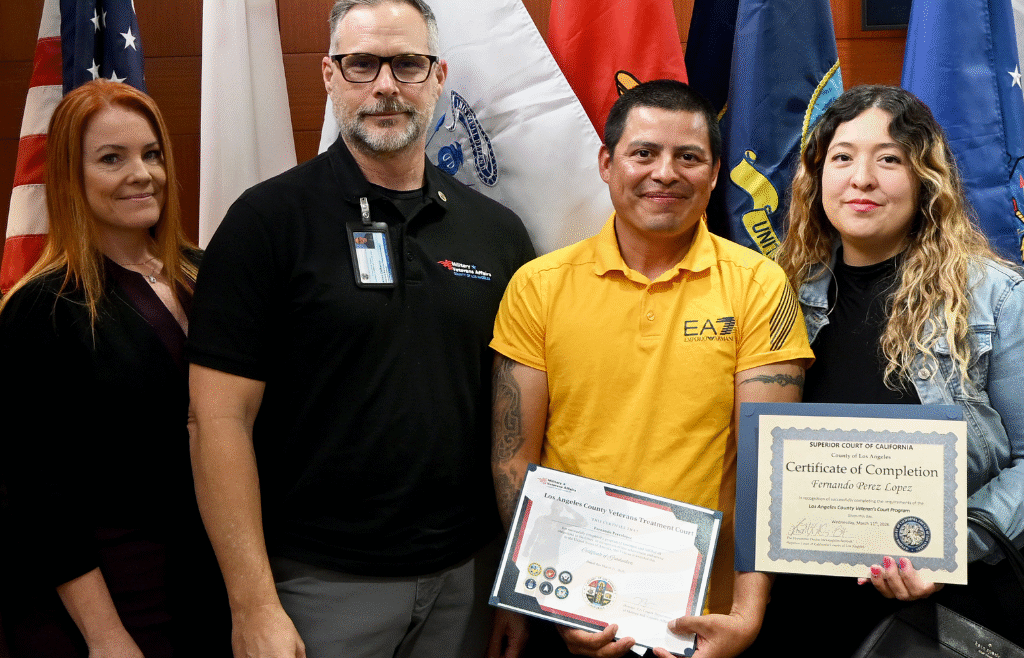
Group in a courtroom stands with a Veterans Treatment Court graduate holding certificates, with U.S. and military flags and the Los Angeles County seal in the background.

James DeBacco’s Second Chance, From Incarceration to Impact

LOS ANGELES (April 2026) — For James DeBacco, a second chance was not a single moment. It was a decision, made day after day, to rebuild a life with purpose. 

After serving 30 years in prison, DeBacco, a Marine Corps veteran, reentered the community in 2019 facing a reality familiar to many justice-involved individuals: limited opportunities and an uncertain path forward. 

“I didn’t know what to do with my life,” he said. “Because who’s going to hire somebody like me? I didn’t have any skill sets.” 

Today, DeBacco serves as a Veterans Treatment Court liaison with the Los Angeles County Department of Military and Veterans Affairs (MVA) Justice-Involved Veterans (JIV) Division. He is also completing his doctorate, continuing a path shaped by growth, accountability, and service. 

His path to that work began long before his release. DeBacco grew up in foster care and later served in the military before his incarceration. After his release, he faced the challenge of rebuilding stability and navigating unfamiliar systems. 

“You go through life and you don’t know anything,” DeBacco said. “And it takes people that trust you and want to believe in you to actually allow yourself to start believing in yourself.” 

For DeBacco, that turning point came through education, connection and the people who saw him beyond his past. He earned an associate’s degree in human services with a focus on addiction studies, followed by a Bachelor of Science degree and a Veteran Services certificate from California State University, Los Angeles. He later completed his Master of Social Work at USC. 

“I live by a simple philosophy, that I’m trying to elevate myself to the highest level that I can so that I can reach back and lift others up to join me,” he said. 

DeBacco also confronted difficult experiences from his military service, including surviving military sexual trauma, something he said was critical to his ability to move forward. 

“That’s not easy to even talk about,” DeBacco said. “But it was being able to talk about that… that enabled me to move forward.” 

That personal experience now informs his work with justice-involved veterans. In his role with the JIV Division, DeBacco helps veterans navigating the court system connect to housing, behavioral health care, benefits and other support that can help stabilize their lives. 

“Where I’m at today in my life is light years from where I’ve come from,” he said. “But it’s because of those experiences that I’ve gone through as how I’m able to reach across the aisle and talk to judges, talk to DAs, and openly have communication and conversations with people that I used to hold contempt.” 

In Veterans Treatment Court, DeBacco works with justice system partners to connect veterans to treatment, services and support aimed at long-term stability. 

“To be a part of the Justice-Involved Veterans Division has got to be the greatest honor that I could ever acknowledge in my life because it really shows that what we’re trying to do is to change lives,” he said. 

That mission is rooted in understanding the trauma many veterans carry, whether from combat, military sexual trauma, personal hardship or the difficult transition from military to civilian life. 

“Trauma is real,” DeBacco said. “But the bottom line is that many veterans don’t really understand when they’re experiencing trauma.” 

For DeBacco, veteran-specific support matters because military service leaves an imprint that is not always visible to others. 

“Veterans go through experiences that nonveterans will never understand,” he said. “From the moment you sign your name on that dotted line, from the moment you step off that bus and for Marines who land on those yellow footprints, your world now becomes transformed.” 

That understanding shapes how the JIV Division approaches its work. DeBacco said the goal is not to excuse harm or erase accountability, but to recognize the humanity of veterans who are struggling and help them access treatment, services and a path forward. 

“Just because you’ve made some poor decisions and bad choices in your past doesn’t mean you’re thrown away,” he said. 

In Veterans Treatment Court, DeBacco sees that transformation take shape over time. 

“It’s exciting to see somebody go through a 12- to 18-month process, get their life back on track and be rebirthed back into society,” he said. 

Second Chance Month, observed each April, recognizes the importance of creating real opportunities for people impacted by the justice system to rebuild their lives. For DeBacco, that meaning is deeply personal. 

“I think having a second chance is priceless,” he said. “Having people believe in you for who you are, not for what you’ve done in the past and risen above, but who you are in the moment and what you represent as a human being in the present.” 

Today, DeBacco is helping others find the support, patience and belief that helped change his own life. Through the JIV Division, that work continues across Los Angeles County, connecting justice-involved veterans to services, dignity and the possibility of a different future. 

Story by Ashley Cohen, Public Information Associate, Los Angeles County Department of Military and Veterans Affairs

Apr 15, 2026 — Veterans Advisory Commission – April

Aerial view of Bob Hope Patriotic Hall with a banner overlay reading “We’re Hiring,” alongside a QR code and the Los Angeles County Military and Veterans Affairs logo.

Now Accepting Applications: Chief Deputy, Los Angeles County Department of Military and Veterans Affairs

LOS ANGELES (April 2026) — Los Angeles County is accepting applications for Chief Deputy of the Department of Military and Veterans Affairs (MVA), a key leadership role shaping how veterans access services across Los Angeles County.

This position helps lead the work that connects veterans and their families to housing, employment, mental health care, and earned benefits, in coordination with County departments, community partners, and policymakers to improve access and outcomes.

From initiatives like the Veteran Peer Access Network (VPAN) to homeless services and suicide prevention efforts, this role supports programs that meet veterans where they are and help move them forward.

What this role does:

  • Leads operations and strategic direction for veteran services across LA County
  • Oversees a team of approximately 70 staff
  • Works across County leadership and partners at all levels
  • Strengthens programs that expand access to benefits, housing, and career pathways

Who should apply:

  • Experienced leaders with at least five years managing complex programs or operations
  • Background in areas such as personnel, budgeting, contracts, or administration
  • Experience working with diverse stakeholders, including government, nonprofits, and community partners
  • Strong ability to develop programs, manage resources, and drive results
  • A bachelor’s degree is required; advanced degrees and veteran experience are valued

Salary Range: $152,556 – $237,255

View full details and apply: https://www.governmentjobs.com/careers/lacounty/jobs/4971205/chief–deputy-military-veterans-affairs-uc

Know someone who would be a strong fit? Share this opportunity.

MVA Monthly Thread – March 2026

Vietnam War veteran speaks at a podium during a luncheon at Bob Hope Patriotic Hall, as fellow veterans seated at round tables listen, with U.S. flags and a Los Angeles County Military and Veterans Affairs display in the background.

Luncheon Honors the Legacy of Vietnam War Veterans

LOS ANGELES (March 2026) — Vietnam War veterans, their families, and community members gathered at Bob Hope Patriotic Hall, March 28, for a Vietnam Veterans Luncheon hosted by the Warrior Heritage Foundation (WHF) in partnership with the  Los Angeles County Department of Military and Veterans Affairs (MVA), recognizing the service and lasting impact of those who served during the Vietnam War. 

Held in honor of Vietnam War Veterans Day, observed annually on March 29, the luncheon created space not only to mark the national day of recognition, but to reflect on the enduring influence of Vietnam War veterans whose service continues to shape families, communities, and future generations. 

In opening remarks, MVA Director Jim Zenner shared that his appreciation for Vietnam veterans is deeply personal, shaped in part by his father’s service during the Vietnam War. He also acknowledged the role Vietnam veterans have played in shaping the department’s work and his own leadership. 

“I have had many Vietnam veterans mentor me since I took this position, teaching me about the history and the objectives that Vietnam veterans had for this department and the County. What you continue to do means a lot. Success here in Los Angeles County couldn’t happen without you and your generation and what you do, mostly behind the scenes,” said Zenner. 

The program included an open mic, where attendees were able to speak, offering brief reflections and information. The exchange created a more intimate moment within the broader gathering. 

Throughout the event, conversations across tables reflected a shared understanding of service, resilience, and the lasting impact of the Vietnam veteran community. Family members and community partners engaged alongside veterans, reinforcing the generational reach of military service. 

Together, these moments formed a meaningful tribute grounded in lived experience. The luncheon served as a reminder that honoring Vietnam veterans extends beyond recognition, it lives in connection, in continued service, and in the enduring legacy carried forward by those who served. 

Story by Ashley Cohen, Public Information Associate, Los Angeles County Department of Military and Veterans Affairs

Veterans gathered around an outdoor table at a deli, sharing breakfast and conversation, while a staff member stands nearby speaking with the group.

Veterans Find Connection Over Breakfast

GLENDORA, Calif. (March 2026) —Veterans from across generations gathered for a weekly veteran breakfast on Tuesday, March 24, at Kara’s Korner Deli in Glendora, turning a simple meal into a space for connection, shared experiences, and ongoing support.

Owner Kara Larson has watched it grow from just a handful of attendees into a weekly tradition embraced by the community. 

“We started with about five or six gentlemen, and now we’re up to 80 to 100,” Larson said. “It warms my heart. They’re the most wonderful men and women you’ll ever meet.” 

What began as a small effort to bring veterans together has grown into a consistent weekly space for connection. 

“We started this just to honor veterans,” said Ray Osborne, a Marine Corps veteran who helped launch the breakfast. “I wish we could clone it for other places for people.” 

The support extends beyond those seated at the tables, with community members showing appreciation in small but meaningful ways. 

“Cars drive by and honk, people make signs. It’s very touching,” Larson said. “We love having the veterans here and appreciate their service.” 

The weekly gathering has become a consistent space where veterans can reconnect, build new relationships, and find a sense of belonging among others who share similar experiences. 

“I’d like to say that this is one of the best things that’s ever happened because you meet guys that you think you forgot about,” said Dale Compton, an Army veteran who was stationed in Germany. “The only requirement here is that you wore the uniform.” 

The space brings together veterans from all backgrounds and ranks, creating an environment where everyone is welcome. 

“It makes a whole big difference if you don’t think you’re worthy,” Compton said. “We have everybody here, from privates all the way to generals.” 

For many, the breakfast is more than a routine. It is a meaningful part of their week and a place to share openly with others who understand. 

“I’m a Vietnam-era veteran, and I come here every Tuesday morning to have breakfast with my brothers and sisters,” said Michael Shuner. “It’s a place where we can share conversation, talk about our experiences, and just connect. Tuesdays are the highlight of my week.” 

On March 24, the breakfast also included participation from the Veteran Peer Access Network Supervisorial District 1 (VPAN SD1), bringing additional resource connections directly to attendees. 

“It’s a nice event to provide resources to the community and support local businesses,” said Leo Chirinos, VPAN SD1 Program Manager. “It’s really nice to get out here, break bread with veterans, and show them there are a whole range of resources available.” 

VPAN connects veterans to critical services, including housing and legal assistance, mental health support, and help navigating benefits and claims. 

“We’re so thrilled when we have different organizations such as the Los Angeles County Department of Military and Veterans Affairs come here and make resources available,” said Keith Bushey, a founding member, known to friends as “The Colonel”. “If you’re a veteran within a country mile of Glendora and want to have some great chow and even better company, come on over on Tuesday mornings. We’d sure love to see you.” 

While the March 24 event introduces additional resource support, the heart of the gathering remains the same, creating a space where veterans feel seen, valued, and connected. 

Story and photo by Layla Romero, Public Information Staff Assistant, Los Angeles County Department of Military and Veterans Affairs

Mar 18, 2026 — Veterans Advisory Commission – March

MVA Monthly Thread – February 2026

  • 1
  • 2
  • 3
  • 4
MVA Logo
  • Quick Links

  • Benefits & Services
  • Patriotic Hall
  • About Us
  • Partner Resources
  • Contact Us
  • County of Los Angeles
  • Need Help

  • Veterans Crisis Line
  • 211 LA County
  • Child Support Services
  • Locate Deceased Persons
  • Community Resources
  • Emergency Alerts
  • Register to Vote

Veteran Services

intake@mva.lacounty.gov

Contact our intake team

1-877-452-8387

Contact our intake team

Renting an event space

bobhopehall.org

Contact the Warrior Heritage Foundation

213-765-2023

Contact the Warrior Heritage Foundation

MVA lacounty © 2024 | All Rights Reserved | Terms and Conditions | Privacy Policy